
014, Opportune Cost of a Couch

When you don’t invest, you also loose all compounding interest you would have made from the investment. That doesn’t sound all that bad until you look at the numbers in detail. So, let’s look at this in more detail.

Let’s consider a $1,000 gift, a tax return, or just $1,000 you saved at some point in your life. If that money is blown, you not only don’t have the $1,000 from before, but you’d lose all the compounding interest. Still, that doesn’t seem like it’s enough for Average Joe to show restraint and invest in his retirement. So what right? It’s only a grand.

Twenty year old Average blew his $1,000 on a new couch and a great meal at some high dollar steak house. He’s young, working hard and deserved the best. He deserved to splurge with his new found extra money.

Twenty year old Smoking Joe, on the other hand, heeded advice he had heard that investing early is the surest way to maximize his money. So, he invested his $1,000 in a tax sheltered retirement account in a low cost mutual fund with a 10% return over the last 20 years and forgot about it. He never added any money to his investment.

What is the total impact at retirement? A lot. The compounding interest on investments has a massive effect over 20 and 40 years. So much so that at age 60, Smoking Joe could withdraw over $1,800 every year and theoretically never run out of money by implementing the 4% rule withdrawal model. The 4% rule will be covered in a later post. For now, just trust me that it works.

That $1,000 invested at age 20 is literally a $45,259.26 decision. At age 60, Average can’t even remember what his couch looked like. But Smoking on the other hand can buy 1.8 new couches every year if he wanted. That $1,000 is a big decision when looked at with the opportune cost model.

Now, fast forward just a decade. Average and Smoking were sitting at a park watching their kids play. Average said his old couch is 10 years old and he needs a new one. Average was bragging that he bought a good quality couch 10 years ago and it served him well. He went on to say how he had spent his $1,000 tax return on a brand new couch. Smoking commented that he invested a $1,000 tax return at the same time and it was doing fairly well. Curiosity got the best of Average and he had to ask Smoking how the investment did. Smoking pulled out his phone and showed him a the balance of $2,593.74.

Impressed with this, Average was determined to get in on some of this investing. He decided instead to invest $1,000 he had for the new couch immediately and nurse that couch a little longer until he could save up for a couch. So, that’s what he did.

Jump ahead another 10 years. Now Average and Smokey are sitting next to each other at a kids sporting event. Average was proud that he had followed his friend Smokey’s investing advice. Average was telling Smokey that his $1,000 had grown from that initial investment to $2,593.74 just as Smokey’s had done a decade earlier! Again curious, Average was curious about Smokey’s investment. So, again, Smokey pulled out his phone and showed Average his $1,000 had grown to $6,727.50.

This can go on and on, but I summarized how $1,000 will grow from age 20 to age 60 below in a chart. You can see that by delaying 10 years, Average’s investment would be only $17,449.40 versus Smokey’s $45,259.26. That 10 year delay for Average’s investment cost him more than half of what it could have been had he invested earlier.
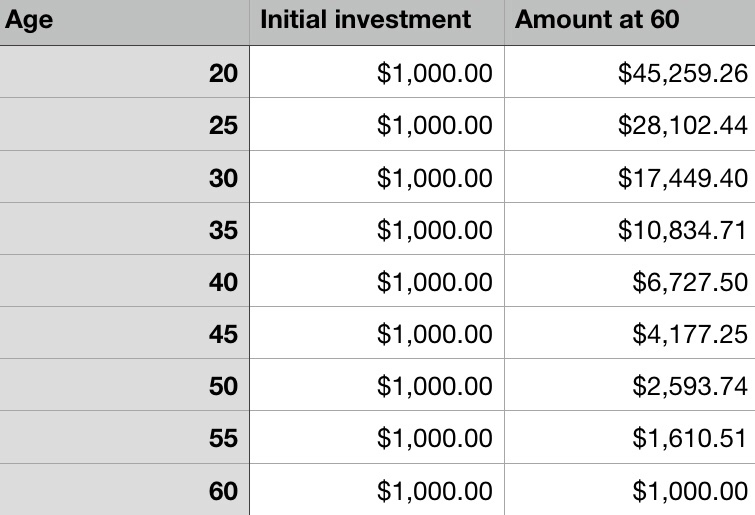
You can check my numbers here.

The above examples shows the power of compounding interest. It’s a very powerful tool that you should take advantage of as soon as possible. The earlier the better in the long run. If you miss the early opportunities, you’ll have to put a lot more of your money away to have the same wealth that you would have if you invested earlier. A late start is still much better than not starting at all. So, don’t delay in getting started.

That $1,000 couch can cost you $45,259.26 in your retirement. Was it worth it?

013, Mortgaging a House

architecture clouds daylight driveway
Photo by Pixabay on Pexels.com

So, we covered ratios in the last post. The focus of that post was to show you the basics of a ratio for buying a house. Now you know and understand the ratios that are recommended in relation to your income. You understand that the 20% recommended down payment is the minimum you should put down on a house. Let’s run through a few examples to show you the impacts of a few scenarios. Sometimes a picture is worth a lot of words. In this case, the picture will be a spreadsheet. Before we get started, here are some of the areas we’ll cover.

I ran all of the calculations through Mortgagecalculator.org. It has the most complete variables necessary to truly capture all of the costs. Be wary of the bank calculators that only show principle and interest. While that’s a big portion of your monthly rate, it’s not the whole picture. So, I’m going to lay out a few things in this post to help you truly capture the total costs you can expect.

First, there’s the purchase price. You may hear people say things like “I paid $200,000 for the house”. They are referring to the purchase price. By the end of this post, you will know the cost of the house will be much more than the purchase price… unless you pay in cash.

Then there’s the down payment. You’ll want to put 20% or more down on a house so you avoid paying PMI (Private Mortgage Insurance). Remember that’s where you get to pay for the bank’s insurance in case you don’t make good on your money. That 20% should be your minimum. You can put down as much more as you want.

Next comes taxes. You can’t get away from taxes. Taxes can be a considerable expense…especially in Texas, where I’m writing this post. What Texas loses in income tax, they make up for in property taxes.

You’ll also want to have insurance. This isn’t the PMI insurance. This is the homeowner’s insurance that you pay for things like a hail storm that trashes your roof, fence, etc. The bank will require you to have insurance if you finance. If you pay in cash, it’s a good idea to pay just to protect your home from an unexpected diseaster.

What we’ve covered above is referred to as PMTI. PITI is simply Principle, Interest, Taxes and Insurance. Everyone will pay those when financing a home. But don’t forget or confuse PITI with PMI. Remember PMI is that insurance for the bank that you get to pay. So, the total monthly cost will be PMTI plus PMI. The less you put down the more PMI’s cost goes up.

In order to show the differences in PMTI plus PMI, I’ll set a few variables so you can see the impact of the changes. I’ll also randomly choose Grand Prairie, Tx as our city of choice to nail down the exact taxes for a property. Limiting the variables should help you see the long term impacts to your finances for the choices you make.

The house will be a $200,000 house in Grand Prairie, Tx. The interest rate is going to be set to 4.33% which is fairly close to the current rate. Your rate will likely vary somewhat based on down payment and your credit score. So, 4.33% is good for illustration purposes. The property taxes for Grand Prairie are 2.921736% of your home value or $5,843.47 every year. That amount will be divided by twelve and added to your monthly payment. Homeowner’s insurance is set at $1,000 per year. Again this will be broken down and spread across your monthly payments. The three scenarios will be putting 5%, 10%, 20% down for your down payment.  The Term will also be either a 30 year or 15 year fixed rate mortgage.

Price Down Pmt % Down Term (yrs) # PMI Pmts Montly Pmt Total PMI Pd Total Int Paid Cost for House
$200,000.00 $10,000.00 5% 30 79 $1,592.98 $7,679.17 $149,698.07 $357,377.24
$200,000.00 $20,000.00 10% 30 71 $1,539.23 $5,325.00 $141,819.22 $347,144.22
$200,000.00 $30,000.00 15% 30 40 $1,485.40 $2,833.33 $133,940.37 $336,773.70
$200,000.00 $40,000.00 20% 30 0 $1,364.90 $0.00 $126,061.53 $326,061.53
$200,000.00 $10,000.00 5% 15 37 $2,086.49 $2,929.17 $68,666.11 $271,595.28
$200,000.00 $20,000.00 10% 15 26 $2,006.69 $1,950.00 $65,052.11 $267,002.11
$200,000.00 $30,000.00 15% 15 14 $1,926.89 $916.70 $61,438.10 $262,354.80
$200,000.00 $40,000.00 20% 15 0 $1,780.42 $0.00 $57,824.10 $257,824.10

Take a good look at the chart.  Study it for a bit and see if you can find the Big Rocks.

The first thing I see is that the final cost for the house could be anywhere from $257,824.10 to $357,377.24.  So, depending on how you set up financing for your house, you could pay a lot more.  Maybe this would help with some perspective on just how much that is.  Let’s say you make $57,000 per year.  If you are inefficient you would work for more than 3 years just to pay for the interest and PMI if you put minimal down and finance for 30 years.  You’d only have to work for one year to pay for the interest if you put 20% down and got a 15 year mortgage.

The second thing I see is that by far, the biggest difference in what you pay in interest is determined by the length of financing.  The longer you finance, the more you pay in interest.  Many folks say that they will finance for 30 years and pay early.  Statistically, they don’t though.  So, if you are in that small percentage, you’re likely not. I tried that and didn’t do well.  It wasn’t until I locked myself into the 15 year mortgage that I actually stuck to it.

The last thing I see is more of a reflection.  Being in the military, I’ve never truly owned any houses. I mortgaged them.  So, I’ve pretty much have been paying interest for most of my adult life.  While I did make money on every house I’ve mortgaged, it was done through improvements, etc.  I’ve never run the numbers, but I’d be lucky to break even considering all the interest I paid.  I wonder if I would have come out cheaper if I only rented and paid cash for a house.

So, as you can see from the chart above, there’s a lot of ways you can buy a house. This post points out a few different ways and for many different lengths of time.  Use this information and the thoughts to do it as efficiently as you possible can.  In just this one example, it could mean you save about $100,000.  What can you do with $100,000????

You now have the tools to make an efficient decision. Don’t be Average!